
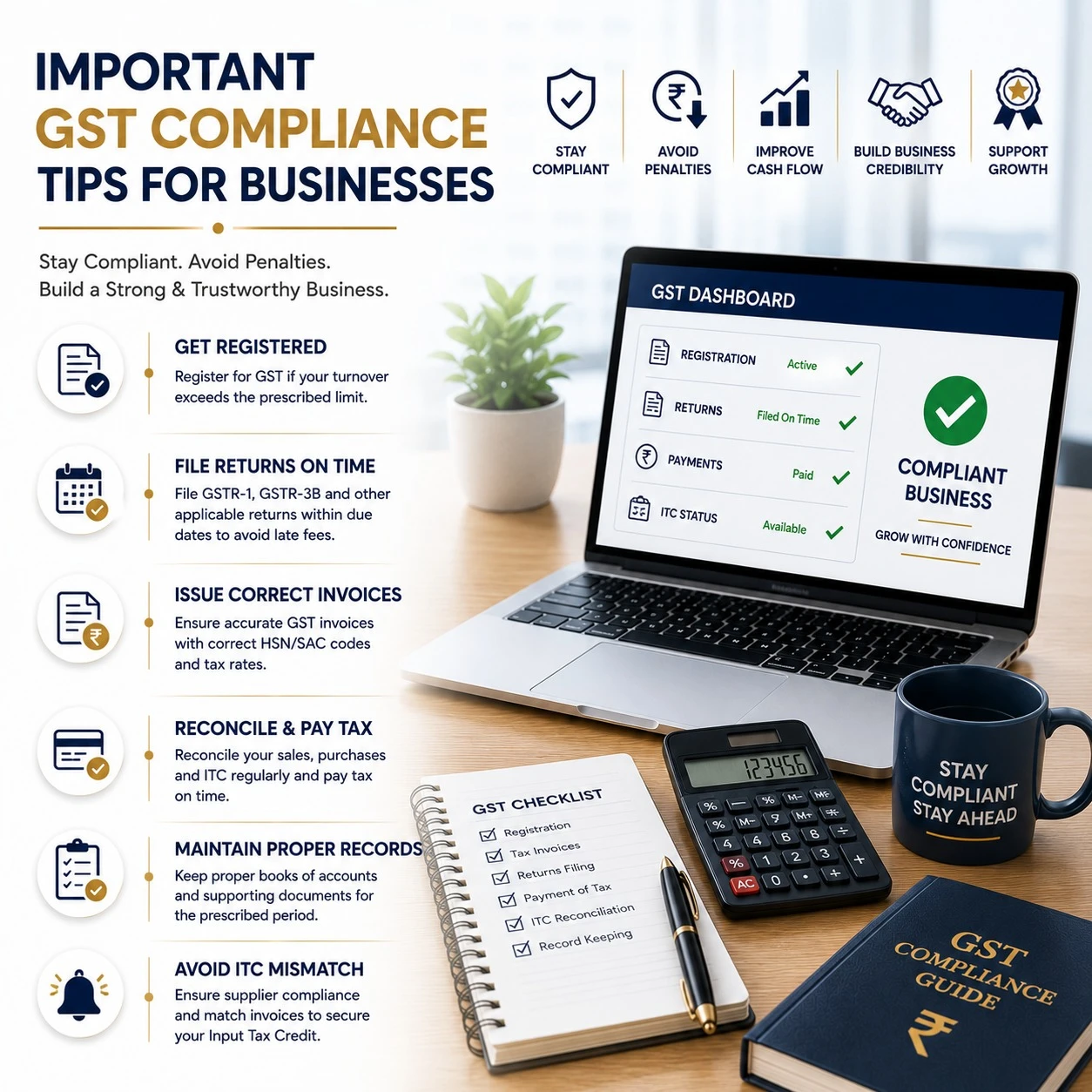
GST compliance is essential for every registered business in India. Failure to follow GST rules can lead to penalties, interest charges, and legal issues. Here are the most important GST compliance tips businesses need to follow in 2026 to stay compliant and avoid problems.
Register for GST before your annual turnover crosses ₹20 lakh (₹10 lakh for special category states). Complete registration early, provide accurate information, and obtain your GSTIN. Register separately for each state if you operate in multiple locations.
Effective GST compliance minimizes legal risks, improves financial transparency, and supports long-term business growth.
Keep detailed records of all sales and purchase invoices, credit notes, bank statements, payment receipts, and stock registers. Preserve all GST-related documents for at least six years from the filing date. Use GST-compliant accounting software for better management.
Every GST invoice must include:
Unique invoice number and date
Supplier and customer GSTIN
Product description with HSN/SAC code
Taxable value and GST rate
CGST, SGST, or IGST breakdown
Total invoice value
For businesses with turnover above ₹10 crore, e-invoicing is mandatory.
Key returns to file:
GSTR-1: Sales details (by 11th next month)
GSTR-3B: Summary return with tax payment (by 20th next month)
GSTR-9: Annual return (by 31st December)
Late filing attracts ₹50 per day penalty (maximum ₹5,000) plus 18% annual interest on unpaid tax.
Reconcile ITC monthly by matching your purchases with supplier filings in GSTR-2A/2B. Claim ITC only for business purposes and items not under the blocked credits list. Reverse ITC for invoices not paid within 180 days as per Rule 37A.
Generate e-way bill for goods movement exceeding ₹50,000 per invoice. Include vehicle number, goods description, quantity, value, and GSTIN details. Non-compliance can lead to penalties up to ₹10,000 and shipment delays.
GST rules evolve regularly. In 2025-26, new changes include:
Mandatory Multi-Factor Authentication for GST portal
Stricter invoice upload timelines (30 days)
Enhanced penalties for non-compliance
Updated HSN/SAC code requirements
Visit the official GST portal regularly and subscribe to update newsletters.
Before March 31:
Review annual turnover for scheme eligibility
File Letter of Undertaking for exports
Ensure HSN code compliance
By April 1:
Reset invoice series for new financial year
Update accounting software
Perform ITC reconciliation
Delaying GST registration beyond threshold
Missing GSTIN on invoices
Incorrect HSN/SAC codes
Late return filing
Claiming blocked input tax credits
Not reconciling ITC with supplier filings
Following GST compliance tips helps you:
Avoid penalties and interest charges
Claim maximum input tax credit
Maintain smooth business operations
Build trust with customers and suppliers
Stay audit-ready
Ensure long-term business sustainability
GST compliance is not just about avoiding penalties—it's about building a credible, efficient business. Implement proper accounting systems, maintain accurate records, file returns timely, and seek professional guidance when needed. Start following these tips today to ensure your business remains compliant and successful in 2026.
Stay compliant, stay profitable!

IntroductionStarting a new business is exciting, but success depends on more than just a great idea....

IntroductionIncome tax planning is not just about reducing your tax burden—it's a strategic app...
Get professional assistance for GST, Income Tax, registrations, compliance, and legal matters today.